The Complete Guide to Pool Water Chemistry & Balancing for Corona Pool Owners
Picture this: It’s a scorching summer day in Corona, California, and you’re ready to dive into your backyard oasis. But instead of crystal-clear water, you’re greeted by cloudy, green, or irritating pool water that makes swimming impossible. This scenario happens to thousands of pool owners every year, and it’s almost always due to one thing—improper Pool Water Chemistry & Balancing. The good news? With the right knowledge and consistent maintenance, you can keep your pool water perfectly balanced, safe, and inviting year-round.
Key Takeaways
• pH levels between 7.2-7.8 are crucial for swimmer comfort and chlorine effectiveness, with 7.4-7.6 being the sweet spot
• Total Alkalinity (80-120 ppm) should be adjusted first as it acts as a pH buffer and makes overall water balance easier to maintain
• The proper chemical balancing order is Total Alkalinity → pH → Calcium Hardness → Sanitizer for optimal results
• Weekly testing is essential using reliable test kits or professional water analysis at local pool stores
• Cyanuric Acid (30-50 ppm) protects chlorine from UV rays but too much reduces sanitizing effectiveness
Understanding the Fundamentals of Pool Water Chemistry & Balancing
When I first became a pool owner, I thought adding chlorine was enough to keep my water clean. I quickly learned that Pool Water Chemistry & Balancing involves much more than just sanitization. Think of your pool water as a delicate ecosystem where multiple chemical factors work together to create safe, comfortable swimming conditions.
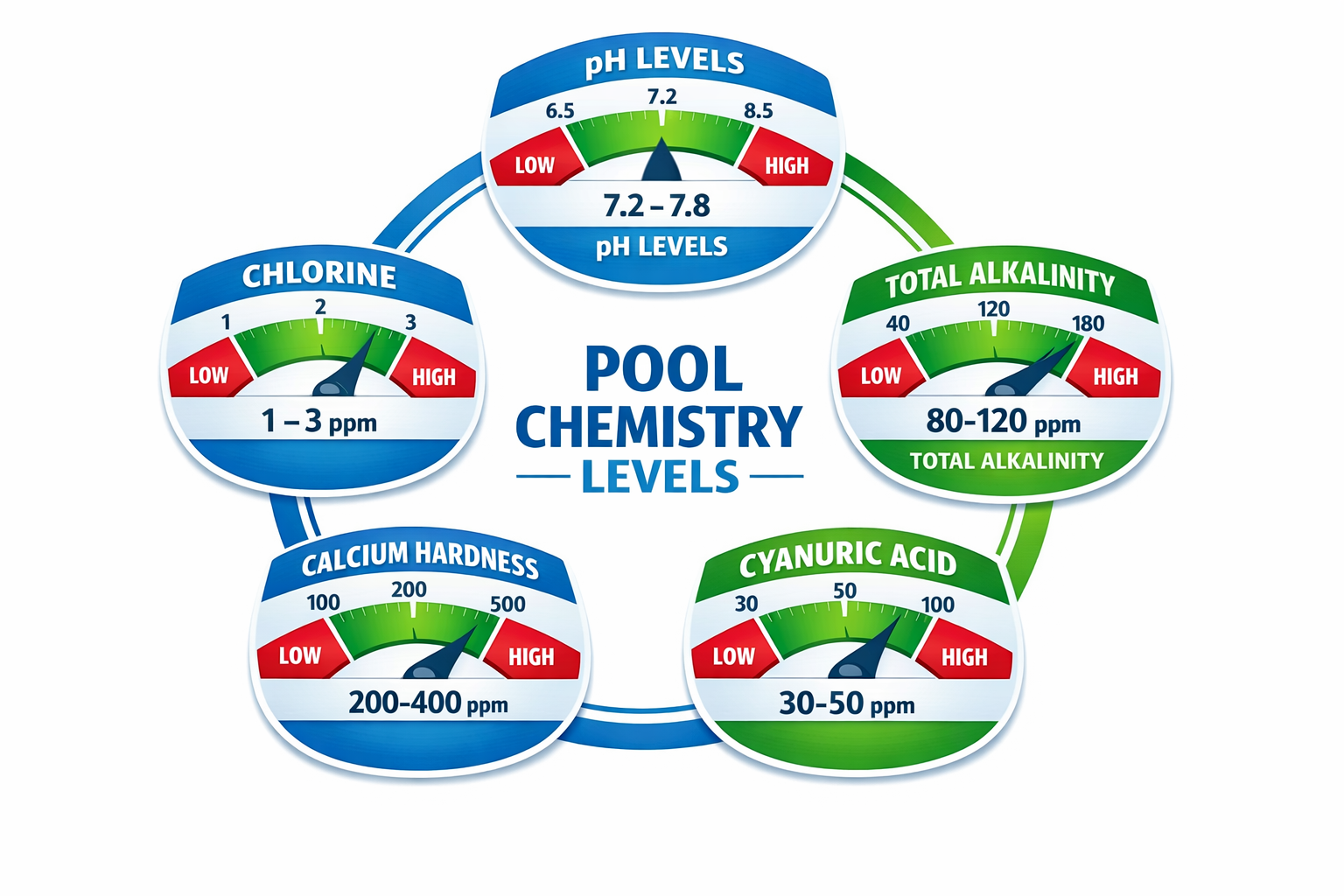
The foundation of proper water balance rests on five critical parameters:
- pH levels (7.2-7.8)
- Total Alkalinity (80-120 ppm)
- Calcium Hardness (200-400 ppm)
- Sanitizer levels (1-3 ppm for chlorine)
- Cyanuric Acid (30-50 ppm)
Why Balance Matters More Than You Think
Unbalanced pool water doesn’t just look bad—it can cause serious problems:
🔸 Equipment damage from corrosive or scaling water
🔸 Skin and eye irritation for swimmers
🔸 Reduced sanitizer effectiveness
🔸 Costly repairs to pool surfaces and equipment
🔸 Health risks from bacterial growth
“Continuous filtration and disinfection remove contaminants but do not balance pool water—a balanced pool specifically requires proper levels of pH, Total Alkalinity, and Calcium Hardness.” [3]
The Science Behind pH: Your Pool’s Most Critical Factor
pH measures how acidic or basic your pool water is on a scale of 0-14. For pools, the ideal range is 7.2-7.8, with 7.4-7.6 being optimal for both swimmer comfort and chemical effectiveness [2][4].
What Happens When pH Goes Wrong?
Low pH (Below 7.2):
- Water becomes acidic and corrosive
- Damages pool equipment and surfaces
- Causes skin and eye irritation
- Makes chlorine dissipate too quickly [5][6]
High pH (Above 7.8):
- Reduces chlorine effectiveness dramatically
- Creates mineral deposits and scaling
- Causes cloudy water
- Leads to skin irritation
The pH-Chlorine Connection
Here’s something many pool owners don’t realize: pH directly affects chlorine’s sanitizing power. When pH drops below 7.2, chlorine disperses much more quickly, requiring significantly more chlorine than needed [6]. Conversely, when pH rises above 7.8, chlorine becomes much less effective at killing bacteria and algae.
Total Alkalinity: The Unsung Hero of Pool Water Chemistry & Balancing
If pH is the star of water balance, Total Alkalinity (TA) is the supporting actor that makes everything possible. TA should be maintained at 80-120 ppm and acts as a buffer for pH, helping prevent rapid fluctuations [2][6][7].
Why Adjust Total Alkalinity First
This is crucial: Total Alkalinity should be adjusted before pH because the chemicals used to balance TA also impact pH levels [2][7]. When TA is properly balanced, pH becomes much more stable and easier to maintain.
| Total Alkalinity Level | Effect on Pool Water |
|---|---|
| Below 80 ppm | pH bounces rapidly, difficult to control |
| 80-120 ppm | Optimal range – pH stays stable |
| Above 120 ppm | pH becomes hard to lower, scaling issues |
Adjusting Total Alkalinity
To Lower High TA:
- Use sodium bisulfate (Dry Acid) or muriatic acid
- Dry Acid recommended for fiberglass, vinyl liner, or painted pools [2]
To Raise Low TA:
- Use sodium bicarbonate (baking soda)
- Test for metals first when both TA and pH are low [2]
Calcium Hardness: Protecting Your Pool Investment
Calcium Hardness measures dissolved calcium in your pool water and should be kept between 200-400 ppm to prevent scaling and etching of pool surfaces [1][4].
The Goldilocks Principle of Calcium
Too Low (Under 200 ppm):
- Water becomes aggressive and etches plaster
- Damages pool surfaces and equipment
- Solution: Add calcium chloride
Too High (Over 400 ppm):
- Creates scaling on surfaces and equipment
- Causes cloudy water
- Solution: Partial drain and refill to dilute [1]
Just Right (200-400 ppm):
- Protects pool surfaces
- Maintains equipment longevity
- Keeps water clear and balanced
Sanitization: Chlorine, Bromine, and Effective Pool Water Chemistry & Balancing
Sanitizers kill bacteria, viruses, and algae to keep your pool safe for swimming. The most common options are chlorine and bromine, each with specific requirements.
Chlorine: The Gold Standard
Chlorine levels should remain constant at 1-3 ppm for effective disinfection [1][3][8]. Free Available Chlorine (FAC) is what actually sanitizes your water, so this is the number that matters most.
Types of Chlorine:
- Liquid chlorine (sodium hypochlorite)
- Granular chlorine (calcium hypochlorite)
- Chlorine tablets (trichlor)
- Salt chlorine generators (for saltwater pools)
Bromine: The Alternative
Bromine should be maintained at 3-5 ppm, which is higher than chlorine requirements [1]. Bromine works well in hot water and doesn’t have the strong chlorine smell, making it popular for spas.
The Chlorine Lock Problem
When Cyanuric Acid levels get too high (over 50 ppm), you may experience “chlorine lock” where chlorine becomes ineffective at sanitizing despite showing proper test levels [2][3]. The only solution is dilution through partial draining and refilling.
Cyanuric Acid: The Chlorine Protector
Cyanuric Acid (CYA) acts as sunscreen for chlorine, protecting it from being destroyed by UV rays. Outdoor pools should maintain 30-50 ppm for optimal protection [1][2][3].
CYA Guidelines by Pool Type
New Pool Setup:
- Add enough CYA to reach 20 ppm initially
- Approximately 2 lbs per 10,000 gallons [3]
- Stabilized chlorine tablets will add more over time
Saltwater Pools:
- CYA is particularly important to prevent the salt cell from overworking [4]
- Maintains same 30-50 ppm range
Testing Frequency:
- Test CYA levels monthly (they fluctuate less than chlorine) [3]
- Reduce high levels only through dilution
Special Considerations for Saltwater Pool Chemistry
Saltwater pools have gained popularity in Corona due to their softer feel and reduced chemical handling. However, they still require careful attention to Pool Water Chemistry & Balancing.
Saltwater Pool Parameters
Ideal Ranges for Salt Pools:
- pH: 7.4-7.6 (slightly narrower range) [4]
- Total Alkalinity: 80-120 ppm [4]
- Calcium Hardness: 200-400 ppm [4]
- Salt Level: 2700-3400 ppm (varies by system)
- Cyanuric Acid: 30-50 ppm [4]
Salt Cell Maintenance
The salt chlorine generator is the heart of your saltwater system. Proper water balance protects this expensive component and ensures efficient chlorine production.
The Correct Order for Pool Water Chemistry & Balancing
Getting the sequence right saves time, money, and frustration. Here’s the proven order for balancing pool chemicals [6][7]:
Step-by-Step Balancing Process
- Test and Adjust Total Alkalinity (80-120 ppm)
- Test and Adjust pH (7.2-7.8, ideally 7.4-7.6)
- Test and Adjust Calcium Hardness (200-400 ppm)
- Add Sanitizer (chlorine 1-3 ppm or bromine 3-5 ppm)
- Test Cyanuric Acid Monthly (30-50 ppm)
Why This Order Matters
Total Alkalinity first because it stabilizes pH levels and makes overall water balance significantly easier to maintain [5]. Trying to adjust pH before TA often results in a frustrating cycle of overshooting targets.
Testing: The Foundation of Proper Pool Water Chemistry & Balancing
You can’t balance what you don’t measure. Pool water should be tested at least once a week using a reliable test kit or professional water analysis [4].
Testing Options
Home Test Kits:
- Test strips: Quick but less accurate
- Liquid drop kits: More accurate, better for precise adjustments
- Digital testers: Most accurate but more expensive
Professional Testing:
- Take water samples to local pool stores
- More comprehensive analysis
- Expert recommendations included
- Typically free with chemical purchases
When to Test More Frequently
🌡️ Hot weather (increases chemical consumption)
🏊♀️ Heavy pool usage (more contaminants)
🌧️ After rain (dilutes chemicals, adds contaminants)
🧪 After adding chemicals (verify proper levels)
🦠 Algae or clarity issues (daily until resolved)
Troubleshooting Common Pool Water Chemistry & Balancing Issues
Even with regular maintenance, pool owners occasionally face water balance challenges. Here are the most common problems and solutions:
Cloudy Water
Possible Causes:
- High pH reducing chlorine effectiveness
- Low chlorine levels
- Poor filtration
- High Total Dissolved Solids (TDS)
Solutions:
- Test and balance all parameters
- Shock treat if needed
- Clean or replace filter
- Consider partial drain if TDS is high
Green Water (Algae)
Immediate Actions:
- Test pH and chlorine levels
- Lower pH to 7.2 if elevated
- Shock treat with 2-3x normal chlorine
- Run filter continuously until clear
- Brush pool surfaces daily
Scaling or Etching
Scaling (white deposits):
- Lower pH and calcium hardness
- Use sequestering agents
- Increase water circulation
Etching (rough surfaces):
- Raise calcium hardness
- Check pH levels
- May require professional surface repair
Seasonal Adjustments for Corona’s Climate
Corona’s warm, dry climate presents unique challenges for Pool Water Chemistry & Balancing. Understanding seasonal variations helps maintain optimal water conditions year-round.
Summer Challenges (June-September)
- Higher chlorine consumption from UV exposure and heat
- Increased evaporation concentrating chemicals
- More frequent testing needed (2-3 times per week)
- Higher CYA requirements for UV protection
Winter Considerations (December-February)
- Reduced chemical consumption but still need sanitization
- Less frequent testing (weekly usually sufficient)
- pH tends to rise in cooler water
- Algae can still grow in mild Corona winters
Advanced Tips for Maintaining Perfect Pool Water Chemistry & Balancing
After years of pool maintenance, I’ve learned some advanced techniques that make water balancing easier and more effective:
The 24-Hour Rule
Always wait 24 hours between major chemical adjustments. This allows chemicals to fully circulate and react, preventing overcorrection.
Keep Detailed Records
Track your test results, chemical additions, and weather conditions. Patterns emerge that help predict when adjustments are needed.
Invest in Quality Chemicals
Premium chemicals often cost more upfront but:
- Dissolve more completely
- Have fewer fillers and impurities
- Provide more consistent results
- Reduce long-term maintenance costs
Pre-Dissolve When Possible
Dissolve granular chemicals in a bucket of pool water before adding to the pool. This prevents undissolved chemicals from settling and potentially staining surfaces.
Cost-Effective Strategies for Pool Water Chemistry & Balancing
Maintaining proper water balance doesn’t have to break the bank. Here are proven strategies to reduce costs while maintaining water quality:
Buy Chemicals in Bulk
Purchase larger quantities of frequently used chemicals like chlorine and acid. Store them properly in a cool, dry location away from sunlight.
Use Generic Alternatives
Many pool chemicals are available in generic forms:
- Muriatic acid instead of branded pH decreaser
- Sodium bicarbonate (baking soda) for alkalinity
- Calcium chloride for hardness increases
Preventive Maintenance
Regular cleaning and maintenance prevents bigger problems:
- Skim debris daily
- Brush walls and steps weekly
- Clean skimmer and pump baskets regularly
- Maintain proper water level
Environmental Considerations and Sustainable Practices
As Corona residents become more environmentally conscious, sustainable pool maintenance practices are gaining importance.
Water Conservation
- Fix leaks promptly to prevent water waste
- Use pool covers to reduce evaporation
- Backwash only when necessary based on pressure readings
- Consider cartridge filters that don’t require backwashing
Chemical Alternatives
- Saltwater systems reduce chlorine handling
- UV sanitizers can reduce chemical usage
- Enzyme products help break down organic contaminants
- Natural clarifiers from plant-based sources
Proper Chemical Disposal
Never pour pool chemicals down drains or storm sewers. Contact Corona’s waste management for proper disposal of expired or unwanted chemicals.
Technology and Automation in Pool Water Chemistry & Balancing
Modern technology has revolutionized pool maintenance, making Pool Water Chemistry & Balancing more precise and convenient.
Automated Chemical Controllers
Benefits:
- Continuous monitoring of pH and chlorine
- Automatic chemical dispensing
- Reduced manual testing and adjustment
- More consistent water balance
Considerations:
- Higher upfront investment
- Still requires periodic calibration
- Manual testing still recommended weekly
Smart Pool Monitors
WiFi-enabled devices that float in your pool and send water chemistry data to your smartphone:
- Real-time monitoring of multiple parameters
- Alert notifications when levels are off
- Historical tracking of water conditions
- Weather integration for predictive adjustments
Mobile Apps
Several apps help track pool maintenance:
- Log test results and chemical additions
- Set reminders for testing and maintenance
- Calculate chemical dosages
- Track expenses and usage patterns
Professional vs. DIY Pool Water Chemistry & Balancing
Deciding between professional pool service and DIY maintenance depends on several factors:
When to Consider Professional Service
- Complex water balance issues that persist despite proper treatment
- Lack of time for regular testing and maintenance
- Expensive equipment that requires expert care
- Health concerns that make chemical handling difficult
- Vacation or extended absence requiring ongoing care
DIY Advantages
- Cost savings on service fees
- Complete control over chemical quality and timing
- Learning opportunity to understand your pool better
- Immediate response to problems as they arise
- Satisfaction of maintaining your own pool
Hybrid Approach
Many Corona pool owners use a combination:
- Weekly professional service for major maintenance
- DIY testing and minor adjustments between visits
- Professional consultation for complex problems
- Seasonal opening/closing by professionals
Building Your Pool Chemical Toolkit
Having the right tools and chemicals on hand makes Pool Water Chemistry & Balancing much easier. Here’s what every pool owner should have:
Essential Testing Equipment
- Reliable test kit (liquid drop preferred over strips)
- Digital pH meter for precise readings (optional but helpful)
- TDS meter for monitoring total dissolved solids
- Thermometer (affects chemical effectiveness)
Basic Chemical Inventory
pH Adjustment:
- Muriatic acid or sodium bisulfate (pH decreaser)
- Sodium carbonate or soda ash (pH increaser)
Alkalinity Control:
- Sodium bicarbonate (alkalinity increaser)
- Muriatic acid (alkalinity decreaser)
Sanitization:
- Liquid chlorine or granular shock
- Stabilized chlorine tablets (for feeders)
- Algaecide for prevention/treatment
Specialty Chemicals:
- Calcium chloride (hardness increaser)
- Cyanuric acid (stabilizer)
- Clarifier for cloudy water
- Stain and scale preventer
Safety Equipment
- Safety goggles and gloves
- Measuring cups dedicated to pool use only
- Mixing bucket for pre-dissolving chemicals
- First aid kit including eye wash solution
Conclusion
Mastering Pool Water Chemistry & Balancing is one of the most valuable skills you can develop as a Corona pool owner. While it may seem complex at first, following the proper sequence—Total Alkalinity, pH, Calcium Hardness, then sanitizer—makes the process manageable and predictable.
Remember these key principles:
- Test regularly and keep detailed records
- Adjust gradually and allow time between changes
- Follow the proper sequence for chemical adjustments
- Invest in quality testing equipment and chemicals
- Stay consistent with maintenance routines
The reward for proper water balance extends far beyond clear, sparkling water. You’ll protect your investment in pool equipment and surfaces, ensure safe swimming conditions for your family, and enjoy the peace of mind that comes with a well-maintained backyard oasis.
Your Next Steps
- Test your current water balance using a reliable kit or professional analysis
- Create a maintenance schedule with weekly testing and monthly deep analysis
- Stock up on essential chemicals based on your pool’s typical needs
- Document everything to identify patterns and improve efficiency
- Consider upgrades like automation or professional consultation for complex issues
With consistent attention to Pool Water Chemistry & Balancing, your Corona pool will provide years of safe, enjoyable swimming for you and your family. The investment in proper maintenance pays dividends in equipment longevity, swimmer comfort, and overall pool enjoyment.
References
[1] Pool & Hot Tub Alliance. (2026). Certified Pool Operator Handbook.
[2] National Swimming Pool Foundation. (2026). Pool Water Chemistry Guidelines.
[3] Association of Pool & Spa Professionals. (2026). Cyanuric Acid Management Best Practices.
[4] Salt Water Pool and Spa Association. (2026). Saltwater Pool Chemistry Standards.
[5] Centers for Disease Control and Prevention. (2026). Healthy Swimming Guidelines.
[6] International Association of Certified Pool Professionals. (2026). Water Balance Fundamentals.
[7] Pool Industry Research Institute. (2026). Chemical Adjustment Sequencing Study.
[8] World Health Organization. (2026). Swimming Pool Water Treatment Guidelines.
SEO Meta Title: Pool Water Chemistry & Balancing Guide 2026 | Corona Pools
SEO Meta Description: Master pool water chemistry & balancing with our comprehensive 2026 guide. Learn pH, alkalinity, and chemical balance for Corona pool owners. Expert tips included.